

p. 11-15 Rembrandt
11 REMBRANDT.
... helmet decorated with foliage; but between the heads of the captain and the lieutenant, the tip of his musket appears with the glow of the shot that has just been fired; a man wearing a brown hat with notched edges tries to push the weapon away.1
On the first step of the stairs is a little girl, her body in profile to the right, her head in three-quarter perspective, crowned by jewels, large pearls in her ears, jewels and diamonds on her cape of an indescribable shade of bluish yellow-green; hanging from her belt are a kind of purse and a dead cock. All this, in insane light, bursts dazzlingly between the man in black and the man in red, against the dark background.
Behind the golden-blond hair of this particular little girl, very mysteriously in the middle of her sunlight, we finally discern a cheek, an earlobe and the corner of an eye; there stands a little boy accompanying the blond girl.2 There are painters who copied the painting without ever having discovered this bambino. Because the little girl is so radiant, she overshadows all the objects around her.
It is sometimes like this in nature: when a bright ray of sunlight hits something and illuminates it, everything around it disappears from view; when you suddenly enter a room brightly lit with chandeliers and girandoles, at first you see only the light.
Above this phantasmagoria is the standard-bearer, Jan Visser Cornelissen;3 his doublet,4 sash and coat, are gray-blue-green, embroidered5 and trimmed...

12 MUSEUM OF AMSTERDAM.
... with gold, large gray hat with white and brown feathers;6 he holds his huge banner high and his head, seen from the front, dominates all the others.
Between the heads spaced out on this third plane, above the captain we see also that of a man in a blue doublet, wearing a tall gray hat with green feathers, attached by a precious stone to the gold hatband;7 above the man in red a beautiful head of a bearded man, with a broad plain white collar and a hat with large raised brims;8 two or three other heads of helmeted men; then the rest disappears under the depths of the vault; at the top of the right pillar supporting the vault we can distinguish only a large carved coat of arms. On this coat of arms are written the names of the captain, the lieutenant, the standard-bearer, the two sergeants, the drummer and eleven musketeers, seventeen names in all. But to read them you first need a ladder, and then a magnifying glass, because the letters are almost impossible to decipher in the shadows.
The signature, drawn, on the contrary, in the stream of light, is also rather difficult to read and even find. It is on the first step of the stairs, between the foot of the little girl and the leg of the young musketeer drawing his weapon. This signature, on thickly applied paint then crushed by superimposed strokes of paint and a final glaze of bister and amber, reads: Rembrandt, f. 1642, the d and the t almost intermingled. So, Rembrandt, having been born in 1608, was only thirty-four ...

Interleaved page
This description of the Nightwatch almost copied by Gautier Moniteur 14 April 60.9
“According to the opinion of even a crowd of connoisseurs, The Night Watch by Rembrandt cannot bear comparison with the masterpiece by van der Helst.”10 (cat. Fesch, by George) 11
See the catal. Fesch for the Preaching of St John, and other Rembrandts.12

13 REMBRANDT.
... years old when he completed this masterpiece.13 It is true that ten years earlier he had already created a masterpiece in another genre, the Anatomical Lesson, which dates from 1632 [9].
And what are all these men doing now? where did they come from, and where are they going?
We already know who they are: the musketeers of Captain Cock's company, and we know that all the main characters are portraits after life.
They emerge from their doele, or doelen, from the premises of their company.
All professional guilds, all civic associations, all companies of arquebusiers and crossbowmen had their building where they gathered together for their shared business together or amusement. The buildings of arquebusiers or crossbowmen were called Doelen, which means shooting. The large dark vault is an inner door of the establishment. The place where they are is still a large interior space, from where they will exit into the open air by the staircase that can be seen on the left.
At first glance, however, the light is so strange, so phenomenal, that it has often been thought that a night effect was suggested, and this no doubt contributed to this painting being given the absurd name Night Watch. But once you have studied and understood the ...

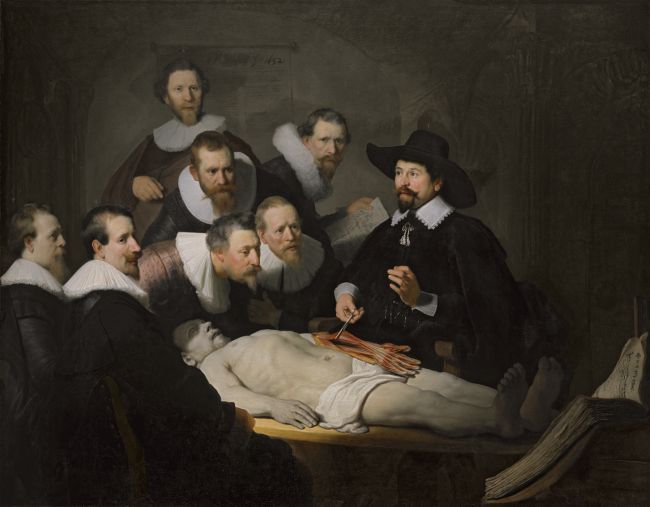
9
Rembrandt
The anatomy lesson of Dr Nicolaes Tulp, dated 1632
The Hague, Koninklijk Kabinet van Schilderijen Mauritshuis, inv./cat.nr. 146
14 MUSEUM OF AMSTERDAM.
... composition properly, you will see that this light, which the genius painter has given a magical effect, is nevertheless very precise and very natural. It comes from the left, through high windows that you do not see in halls of this kind with extremely high vaults, as indicated here by the immense arcade cut off at the top by the frame. The scene takes place "in a lofty hall", as Smith rightly put it.14 It is therefore the light of the sun, of the full sun, that floods the places where the rays fall through the openings; as a result, the spaces where the rays do not fall directly appear darker.
The direction of the light is clearly determined by a peculiarity that catches the eye and that everyone notices: the outstretched hand of the captain in the sunlight, forms a shadowy silhouette on the tail of the light yellow jacket of the lieutenant to his right; and if you look at all parts of the painting, all the groups, all the details, there is nothing to contradict this clue. Everything is correctly lit from left to right, a little from top to bottom, a little from front to back (1).
------
(1) I will quote Ducamp again here because he is the last French critic to write a few pages on the museums of Holland. Because he did not understand the subject of the painting and its location, he said that "the way Rembrandt distributed the light over this canvas is completely arbitrary ... The painting's true sun, the dazzling star ...

15 REMBRANDT.
But where do they go in such a crowd, in this festive, animated atmosphere? Several explanations have been suggested for this.
The author of the Histoire d'Amsterdam (1), Wagenaar, recalls that in the year the painting was painted, "on May 14, 1642, the civic guard had been ordered to be ready for a review on the evening of the 29th, on pain of a fine of 25 florins ... The occasion was the visit of the Prince of Orange who was expected with Princess Mary, the daughter of Charles I, King of England, whom he had just married.15 The painting would thus represent the moment when Captain Frans Banning Cock and his arquebusiers left their doele "to meet the illustrious travelers".
This interpretation was adopted by an English author, ...
------
... projecting its glow and from which an essential light radiates ... Is a little girl running. ..." Du Camp adds "did the artist want to depict a night scene or a day scene? On that we disagree" - Although he is a great admirer of Rembrandt, Ducamp has many reservations and even many criticisms of the Night Watch, which "lacks charm and serenity"; he finds in it "exaggerated brushstrokes that serve no purpose, overly elaborate effects, things which, although he deliberately omitted, are nevertheless culpable ... Rembrandt seemed almost to be in decline [compared to the Anatomy Lesson], for excessive exaggeration is often nothing but weakness. Rembrandt was paid by some militia men to do their portraits. Too carried away by his daydreams of chiaroscuro, he did not give his painting the color the subject required.... etc., etc."16
(1) Beschrijving van Amsterdam (Description of Amsterdam), etc.17

Notes
1 Middelkoop 2019, p. 811, no. 7: Jan Adriaensz Keijser (1594-1664).
2 According to Middelkoop, this is also a girl, Middelkoop 2019, p. 811, no. b.
3 Middelkoop 2019, p. 811, no. 3: Ensign Jan Cornelisz. Visscher (1610-1650).
4 Comment Bianca du Mortier: his doublet has incised bragons on the shoulders.
5 Comment Bianca du Mortier: Instead of embroidered, they may be passements.
6 Comment Bianca du Mortier: with a raised border on either side, on which white and brown feathers on the left.
7 Middelkoop 2019, p. 811, no. 10: Jan Ockers (1599-1652).
8 Middelkoop 2019, p. 811, no. 12: Herman Jacobz Wormskerck (1590-1653).
9 Spoelberch de Lovenjoul 1887, vol. 2, p. 208, no. 1685, published in: Le Moniteur universel, 14 avril 1860.
10 See below, p. 38-39.
11 Sale collection Cardinal Fesch, Rome (George), 17-24 March 1845 (Lugt 17682), part 1, p. 82.
12 Today, only two of these are still considered to be by Rembrandt. See: Fesch sale, part 1, p. 200, no. 189-173, Rembrandt, John the Baptist Preaching, c. 1634-1635, Berlin, Staatliche Museen – Gemäldegalerie, inv. no. 828 K; part 1, no. 190-88, Rembrandt, Portrait of Marten Looten, 1632, Los Angeles County Museum of Art, inv. no. M53.3; part 1, no. 191-89, circle of Rembrandt, A Scholar at His Desk, c. 1644, Cologne, Wallraf-Richartz Museum, inv. no. WRM 2527; part 1, no. 192-91, workshop of Rembrandt, possibly Carel Fabritius, Portrait of a Seated Woman with a Handkerchief, Toronto, Art Gallery of Ontario, inv. no. 65/59; Jan Lievens, Head of an Old Woman with a Head Scarve, Seen in Profile, c. 1629, New York, private collection; part 1, p. 214, no. 194-83, Govert Flinck, Self-Portrait, c. 1640, Glasgow, Kelvingrove Art Gallery and Museum, inv. no. 44; part 1, no. 195-84, attributed to Govert Flinck, Portrait of Saskia van Uylenburgh, c. 1637-1638, Amersfoort, Dutch Cultural Heritage Agency, inv. no. NK2608.
13 According to the latest records, Rembrandt was born in 1606 or 1607.
14 Smith 1829-1842, vol. 7 (1836), p. 59, no. 139.
15 Wagenaar 1760-1767, p. 541 (vol. 2, book XV). The Prince of Orange was the later stadholder William II, he married Mary Henrietta Stuart, daughter of Charles I of England, in 1641.
16 Du Camp 1857 , p. 581-585.
17 This is probably: J. Wagenaar, Beschrijving van Amsterdam gevolgd in eene geregelde aanwijzing van de sieraden der publieke gebouwen, Amsterdam 1790. This publication, however, does not contain this quotation, but it can be found in Wagenaar 1760-1767, p. 541 (vol. 2, book XV).