

p. 6-10 Rembrandt
6 MUSEUM OF AMSTERDAM.
... chronological order has the disadvantage of preventing us from following the genealogy of an art movement, and the alphabetical order, which has the sole advantage of facilitating the search by name, is nothing but systematic disorder.
Let us therefore go straight to the most famous painting by the most famous Dutch painter, to Rembrandt's Night Watch.
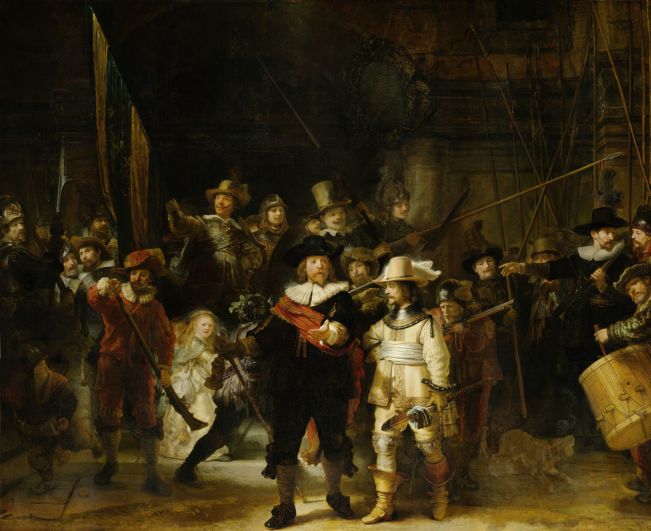
REMBRANDT.1 – From2 top to bottom and left to right, The Night Watch occupies the entire right wall of the museum's main room [8];3 it receives light through the windows on the left. This unique painting, with its twenty-three life-size, full-length figures, has a completely unexpected effect. Because it's placed on a simple wooden plinth, only four or five inches high, and because the feet of the figures in the foreground touch the lower edge of the frame, it seems as if the entire bustling crowd is rushing forward, walking into the same space as the viewer, and approaching them.4 After a few minutes, the illusion is so powerful that you think they are real people.
It is amazing that this painting, which cannot be compared to anything, is both the most fantastic and the most realistic in the world!
All who see Night Watch for the first time, ...

8
Rembrandt
Civic guardsmen of Amsterdam under command of Banninck Cocq, dated 1642
Amsterdam, Rijksmuseum, inv./cat.nr. SK-C-5
7 REMBRANDT.
... are shattered (1) and then collapse onto the large bench that is there in the middle of the room opposite the painting. They stay there for a moment, bewildered and silent, then take courage and try to approach the man in black and the man in yellow who come forward at the head of the group.
The man in yellow is of normal height, a little small even (Smith calls him: a short man),5 and you can measure yourself with him, forehead to forehead, eye to eye, foot to foot.
The man in black is taller, and in his simplicity6 he has an appearance that could even be called majestic; which is undoubtedly why almost all French writers, who have never fully understood the subject of composition, call this good man: the mayor (2). But this is knight Frans Banning Kok, or Cock, or Coux, lord of Purmerland and Ilpendam, then captain of a company of the civic guard, later colonel, and commander-in-chief of the entire Amsterdam civic guard.7 But he has no military uniform on, and his only weapon is a sword with a long pommel, suspended from a large red sash,8 ...
------
(1) ''It is perhaps the strangest painting I have ever seen, and I have seen many", says Maxime Ducamp, in the Revue de Paris of October 1857 ... "It amazes you, it makes you pause, it crushes you ... Its color is dazzling, it blinds you, is taken to extremes, etc."9
(2) For example, the late Gustave Planche, in an article in the Revue des Deux-Mondes (July 1853).10

8 MUSEUM OF AMSTERDAM.
... which is embroidered with gold.11 Over his black doublet is a large, pleated collar; black knee breeches; brown stockings. His thick-soled shoes are adorned with black ribbon rosettes. He wears a black, wide-brimmed flap hat. His beard is trimmed à la Louis XIII. He stands frontally, his gloved right hand resting on a long cane. The left hand we see with the fingertips shortened, is extended forward and the man in black makes a gesture as if in conversation; for he is talking to the man in yellow, who is listening to him as he turns his head toward the man in black so that we see him in profile.
This is the lieutenant of the company, Willem van Ruijtenberg, lord of Vlaardingen.12 He is dressed in a doublet made of a rich lemon-colored fabric embroidered with gold,13 a white sash, breeches with ribbons at the knees, chamois colored cauldron boots with gold spurs and saffron-colored gloves with gray glacis.14 His yellowish felt hat is decorated with a hat band of gemstones and long white feathers that float backward. His right hand rests on his hip; his left hand holds a halberd horizontally. This has blue and white tassels and a handle decorated with metal studs.
These two main figures stand slightly in front of the others, roughly in the center of the canvas.
Behind them, a troop of arquebusiers emerges disorderly from a dark vault, in front of which is a staircase. One of them, at the bottom of the stairs, on the right ...

9 REMBRANDT.
... of the captain and almost in the same plane, is loading his musket; he is all in scarlet, except for his stockings, which are the color of a Silver-washed Fritillary15 and an orange feather on his crimson hat; his powder horn, a long horn hanging from a metal chain, is carried by a boy wearing a helmet, who is walking beside him and sliding his hand along an iron handrail, which no doubt leads to a staircase by which the whole company will descend.
This is located at the far left edge of the painting.
Above the boy sits a helmeted man with his long halberd straight up, perhaps one of the sergeants, on a stone balustrade with his upper right leg extended; his foot is hidden behind the man in red. This figure is slightly cut off by the frame.16
On the other side of the painting, on the right, stands the drummer Jan van Kampoort,17 he too is partially cut off by the frame; we can see only half of his good-sized head (1), wearing a hat with turned-up brim, ...
------
(1) Mr. Maxime Ducamp (Revue de Paris), no doubt under the influence of some Italian ideal, does not much like this drummer, "already an old man, with a stricken face, undoubtedly a drinker, not to say a drunkard, ..." nor the captain, "an ugly figure, red and lit despite his slenderness, ... etc."18 – This aversion to the coarseness of Rembrandt's style is anyway endemic among almost all French writers: "The Night Watch suits Rembrandt's realistic and somewhat…

10 MUSEUM OF AMSTERDAM.
... and his right arm beating the drum, on which the light falls brightly.
A little above him one of the sergeants, with his halberd on his left shoulder, extends his right arm as if giving an order; black clothing,19 large, pleated collar, large black hat with a large plume of brown feathers; serious and stunning head.20
The entire right side of the painting, between the lieutenant and the drummer, is in chiaroscuro. Behind the lieutenant's shoulder can be seen a helmeted man holding his musket as if he were going to shoot;21 above the sergeant's hand, a man with a round hat22 with feathers standing, in a greenish-grey costume; a few other heads in helmets or hats; and above them a forest of pikes; there are still a lot of people coming this way. – Against the drummer barks a dog lost in the shadows.
While the lighting effect in particular hesitates over which of the two main characters is more important, the heart of the composition is between the captain and the man in red.
First, a young musketeer emerges from behind the captain; all we see of him is an elongated leg in profile and part of his ...
------
… crude genius," says Viardot (Les Musées de Hollande) ... "The subject required only the real truth, no noblesse, no ideal, no expression ... mere representation of material things ... etc."23

Notes
1 This section on Rembrandt (p. 6-32) was first published in l’Artiste, see: Burger 1858c. Only the references to the new Rijksmuseum catalogue, Amsterdam 1858, which are here on pages 19, 24, 25, 30 and 32, are missing from the article.
2 The 'e' of 'de haut' has been crossed out and replaced in the margin by a 'u', thus: 'du haut'.
3 Rembrandt, The Night Watch Militia Company of District II under the Command of Captain Frans Banninck Cocq, 1642, Amsterdam, Rijksmuseum, inv. no. SK-C-5; Smith 1829-1842, vol. 7 (1836), p. 59-60, no. 139; Aanwijzing 1853, p. 23, no. 228, Rembrandt van Ryn (1606-1674), Een groot Schuttersstuk, algemeen bekend en beroemd onder den naam van de Nachtwacht (A great militia piece, commonly known and famous under the name of the Night Watch) (tax. fl. 500,000); Amsterdam 1858, p. 123-125, no. 275.
4 The plinth and a window on the left can be seen in a painting by the Swedish painter August Jernberg, Visitors in front of Rembrandt’s ‘Night Watch’ at the Trippenhuis, 1885, Malmö, Malmö Konstmuseum, inv. no. MM 2172. A preliminary study in oil, said to date from 1872 is mentioned by Van Thiel in Meischke/Reeser/Van Eeghen 1983, p. 259-261. It is suggested that perhaps an actual event in 1872 is depicted here, such as a royal visit. The gentleman on the right might be Pieter Ernst Hendrik Praetorius, at the time chairman of the Board of Governors of the Rijksmuseum. It seems unlikely, however, that a neat nineteenth-century Amsterdam gentleman would himself take up a feather duster to dust the Night Watch, certainly not in the company of regal visitors. Incidentally, these images show other paintings to the left and right of the Night Watch: it therefore does not occupy the entire right wall of this room.
5 Smith 1829-1842, vol. 7 (1836), p. 59, no. 139.
6 Comment Bianca du Mortier: His clothes are anything but simple. He wears a pack of black fabric; black was one of the most expensive colors at the time. Under his coat he wears a gold-colored garment, possibly made of brocade.
7 According to Middelkoop 2019, vol. 3, p. 810-812, no. S. 84, no. 1, Frans Banninck Cocq (1605-1655) was indeed captain of Wijk 2 at the time, he became colonel in 1647 until 1650; he became overman of the Handboogdoelen in 1648. But this does not mean that he was commander-in-chief of the (entire) Amsterdam civic guard. This is stated in Scheltema 1853, p. 102. In all probability Thoré-Bürger borrowed this statement from Scheltema.
8 Comment Bianca du Mortier: a sword usually hangs from a bandelier and not from a sash.
9 Du Camp 1857, p. 581, 584. The articles that appeared in the Revue de Paris were later published as a book; the passage on the Night Watch: Du Camp 1859, p. 132-141.
10 Planche 1853, p. 264: 'bourgmestre'.
11 Comment Bianca du Mortier: which is not embroidered but trimmed with a gold lace or passement.
12 Middelkoop 2019, p. 811, no. 2: Lieutenant Wilhem van Ruytenburch (1600-1652), later (1646-1647) became captain of Wijk 2.
13 Comment Bianca du Mortier: it is a leather kolder with gold embroidery or passements.
14 Comment Bianca du Mortier: they are gloves with wide hoods trimmed with alternating black and white fringes.
15 Silver-washed Fritillary (Argynnis paphia): a species of butterfly that is a yellow-orange color with brown-black stripes, see butterfly-conservation.org.
16 Middelkoop 2019, p. 811, no. 4: Sergeant Rombout Kemp (1597-1653), later Lieutenant of District 2 (1646-1650).
17 According to Middelkoop 2019, p. 811, no. a: possibly Jacob Jorisz (1591-after 1646) or 'Jan van Kampoort' as suggested in Van Dyk 1758, p. 59.
18 Du Camp 1857, p. 582.
19 Comment Bianca du Mortier: with a sash around the waist.
20 Middelkoop 2019, p. 811, no. 5: Sergeant Reijnier van Engelen (1588-1651).
21 Middelkoop 2019, p. 811, no. 9: Jan Claesz Leijdecker (1597-1640).
22 Comment Bianca du Mortier: with hat band.
23 Viardot 1855, p. 210.