

p. 76-80 Paul Potter, Gerard Dov
76 MUSEUM OF AMSTERDAM.
... and other animals, of all shapes and sizes. On the right, at the edge of the forest, a deer. All this is very cold to the touch, meticulously executed, but very special. "Every object, Smith says, is painted with the most scrupulous attention to detail, but it must be owned that few of the animals possess the characteristic expression peculiar to its kind."1
Indeed, the wild animal falls outside the competence of the "Raphael of cows," as Paul Potter was sometimes given as a grotesque nickname. In the Dutch school, the lions belong to Rembrandt in the Dutch school, just as they do to Rubens and Snyders in the Flemish school. This Orpheus with his menagerie was not at all the subject of Paul Potter, who is neither wild nor mythological. The small herd ruminating in the meadow, on the bank of a canal, the shepherd looking over a fence, the milkmaid milking her beautiful golden cow, plain backgrounds, as far as the eye can see, with microscopic sheep, this is what he needed.
Orpheus, on canvas, about 3 feet wide and over 2 feet high. It is signed Paulus Potter f. 1650. At the Lormier auction in The Hague, 1763, it sold for 1,300 guilders; the following year it dropped to 975 guilders at the Van der Wouw auction. Smith estimated it at 600 pounds sterling in 1834. Today we might boldly double and even triple this valuation.
The landscape with animals is of incomparably superior quality. So Smith estimated it ...

77 PAUL POTTER.
... at 1,500 guineas (about 40,000 francs). In the center a standing red bull, an ox, a reclining cow; then a horse, a donkey, a ram, a goat, two sheep, a lamb. Near a tree, on the right, a standing shepherd plays a bagpipe; a seated woman breastfeeds her child; their black dog is beside them. On the left, the hilly terrain, where sheep and goats graze, is crowned with trees with thin leaves. The background is quite wooded and we see a round tower. Signed and dated 1651. Height 2 feet 3 inches, width 3 feet 2 inches. On canvas. From the Van der Pot auction, 1808, where it was paid 10,050 guilders. A repetition of this painting sold at the Valkenier auction in 1796 for 3,025 guilders; at the Bryan auction, in 1798, 1,170 guineas. It then passed to the Duke of Bedford and was exhibited at the British Institution in London in 1815 (1).
The painter of the Regents and the painter of the Bear Hunt take us with their small paintings to the artists who represented the familiar scenes, the habits of their countrymen of all classes, the various aspects of nature in their country, and who – if we leave out Rembrandt, Van der Helst and a few other masters of large painting – , in particular ...
------
(1) The new cat. indicates that the Amsterdam painting went through the two Valkenier and Van der Pot auctions and seems to know nothing of the repetition that was with the Duke of Bedford in 1834 (see Smith).2

78 MUSEUM OF AMSTERDAM.
... constitute the Dutch school. Genre painters, as they are usually called; painters of morals; rustic painters; painters of the drawing room and the inn, of the city and the countryside, of the woods and the sea; painters of lively nature and peaceful nature; from the elegant conversations of Metsu, the hunts of Wouwerman, the pubs of Van Ostade, the orgies of Steen, the herds of Cuijp, the waterfalls of Ruijsdael and the seascapes of Willem van de Velde, to the pots of Kalf and the flowers of Van Huijsum.
GERARD DOV. – Gerard Dov passes for the most important of Holland's minor painters, while his master Rembrandt is considered Holland's greatest artist.
However, Rembrandt towers high above all his compatriots; he has taken his place in the supreme pleiade, standing above the various nationalities and revered by all mankind. Da Vinci, Michelangelo, Raphael, Correggio, Titian, Velazquez,3 – Jan van Eyck, Albrecht Dürer, Rubens, Rembrandt,– just like Dante, Cervantes, Molière, Shakespeare, Goethe, – belong to all nations (1).
------
(1) Théophile Gautier talked about The Twelve Gods of painting, to which Arsène Houssaye replied that he only knew seven. As for gods, everyone creates what he wants. Besides the ten great men, who are ....

79 GERARD DOV.
Rembrandt is without equal in his country – and in the world. Gerard Dov, on the other hand, has many equivalents in his own country, although no one really resembles him. The three Adriaans (the name is a delight!) – Van Ostade, Brouwer and Van de Velde, – Aalbert Cuijp, Paul Potter, Jan Steen, Pieter de Hooch, Terburg, Metsu, Philips Wouwerman, Willem van de Velde, Ruijsdael, Hobbema, are certainly as good as Gerard Dov, each in his own genre, and each with a different genius.
Holland has the unique privilege of having produced more than a dozen artists who are perfect at what they do. How many painters are outside the lines in other schools of painting, even the most prolific ones? Among the Florentines: Masaccio, Leonardo, Michelangelo, Fra Bartolommeo, Andrea del Sarto; ... among the Venetians: Giovanni Bellini, Giorgione, Tiziano, Tintoretto, Veronese; .... among the Spaniards: Ribera, Velazquez, Murillo, Zurbaran; ... among the Flemings: Jan van Eyck and Memling, Rubens and Van Dijk.4 These great men are no match for the others around them, who followed the same inspiration and translated it, with varying degrees of talent, into the same style.
But it is not like that with the Dutch. Each has his own original character and personal style. Gerard Dov cannot be compared to Van Ostade, ...
------
... mentioned above, the two other artists whom Gautier would want to deify to get to his dozen? Paolo Veronese? Murillo? – Perhaps Poussin, as a gallant gesture to the French school?5

80 MUSEUM OF AMSTERDAM.
... nor Metsu with Jan Steen; Paul Potter does not erase Aalbert Cuijp; nor Ruijsdael Hobbema. All have a very distinct and easily recognizable individual style.
This quality, which comes from the research they can do freely in their country, where imagination, like mind and conscience, are absolutely independent, is one of the causes that have driven up the price of Dutch paintings.
The masters of the Italian school are so closely related that most of their paintings cannot be given their own names, and the works attributed to even the most famous painters are often questionable. When it comes to Italian painting, you can never be sure what you have. Museums themselves cannot vouch for all their Raphaels or Titians unless they have a direct and certain tradition and provenance. Aren't these from Palma and the others from Jules Romain? One does not willingly give 100,000 francs for a painting that may be an imitation from the master's studio, or a copy.
But with the Dutch there is no room for error or deception. The Jeanne d'Aragon attributed to Raphael in the Louvre is almost entirely Giulio's [108];6 but the Dropsical Woman is entirely Gerard Dov's [109], and no one else's.
Once a Dutch painting is recognized, it can never be unrecognized. It is therefore safe to buy it. The Congress of Munster, ...

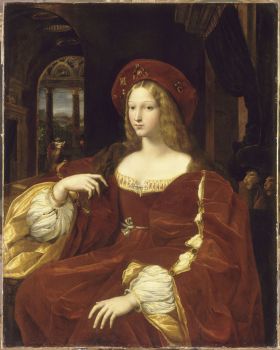
108
Rafaël Raphael and Giulio Romano or Raphael or Rafaël or Giulio Romano
Portrait of Doña Isabel de Requesens (1500-1577), vice-reine of Naples, c. 1518
Paris, Musée du Louvre, inv./cat.nr. 612
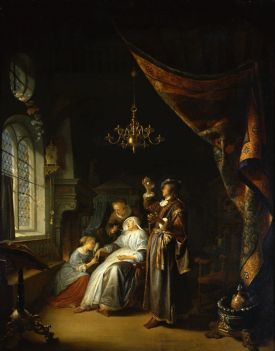
109
Gerard Dou
Dropsical woman, dated 1663
Paris, Musée du Louvre, inv./cat.nr. 1213
Notes
1 Smith 1829-1842, vol. 5 (1834), p. 131, no. 27.
2 Smith 1829-1842, vol. 5 (1834), p. 140, no. 51.
3 The painter Paul Delaroche in his Hemicycle in Paris of 1841 shows more early Italian masters than Thoré-Bürger mentions here (Correggio, Veronese, Antonello da Messina, Murillo, Van Eyck, Titian, Terborch, Rembrandt, Van der Helst, Rubens, Velazquez, Van Dyck, Caravaggio, Bellini and Giorgione, Ruisdael, Paul Potter, Claude Lorrain, Gaspard Poussin, Nicolas Poussin, Giotto, Cimabue, Andrea del Sarto, Michelangelo, Masaccio, Perugino, Raphael, Giulio Romano, Mantegna, Fra Bartolommeo, Domenichino, Leonardo da Vinci, Dürer, Sebastiano del Piombo, Orcagna, Le Sueur, Holbein, Edelinck, Marcantonio Raimondi, Fra Angelico).
4 The 'ij' in 'Dijk' has been crossed out and replaced in the margin by 'yc', thus: 'Dyck'.
5 The statement 'The Twelve Gods of Painting' comes from a text by Théophile Gautier, who, as part of his idea of 'art for art's sake', designated certain painters as models of pure beauty. Arsène Houssaye replied that he knew of only seven, implicitly referring to an article in the Revue des Deux Mondes of 1836, because Gautier would have designated at least five more, which would have made seven. This discussion was later compiled in an 1864 publication, see: Gautier/Houssaye/Sain-Victor 1864.
6 Meanwhile, the name of the sitter has altered, from Jeanne of Aragon to Doña Isabel de Requesens (1500-1577), vice-reine of Naples.