

p. 116-120 Jan Steen, Terburg
116 MUSEUM OF AMSTERDAM.
... than this. Smith had the charming full-length portrait engraved for his vith part [170],1 which was then in the possession of Baron Verstolk van Zoelen of The Hague. It shows the real Jan Steen, singing and laughing, accompanying himself on the mandolin. He is sitting next to a table on which lie some music papers and a jug with something to drink [171].
In the Amsterdam portrait, the face is quite serious and even sad, but always with a touch of sarcasm. The baroque nose points upward, there is a small mustache and long brown hair. On the dark cloak a white collar. To the right, a glimpse of opaque sky. Everything has turned black. Moreover, the painting was never of good quality: indifferently painted, Smith says.2 The signature is on the edge of a window on the right. The nearly square canvas is 2 feet and a few inches high. Engraved by J. de Mare (1) [172].3
"No. 269. A Quack commending his wares" [173].4 He stands on a platform, in the shade of a tree. Many small figures, always very witty, and comic scenes: a woman brings a drunken man in a wheelbarrow, no doubt so that the eloquent doctor can cure him of drunkenness. A peasant is operated on by the quack's accomplice, and so on. Very free and very light execution. On panel. High 1 foot 2 inches, wide 1 foot 7 inches. Another from the Lormier collection: 420 guilders.
------
(1) Purchased from Mr. Hodges for 150 guilders (new cat.).


170
Charles W Marr Charles W. Marr after Jan Steen
(Self)portrait of Jan Steen (1626-1679) as lute player, c. 1663-1665, 1833, 1833
The Hague, RKD – Netherlands Institute for Art History
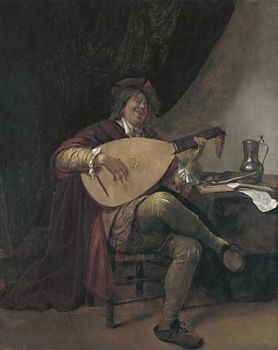
171
Jan Steen
Selfportrait of Jan Steen (1626-1679) as lute player, c. 1663-1665
Madrid (city, Spain), Museo Thyssen-Bornemisza, inv./cat.nr. 373 (1930.110)

172
Johannes van der Kellen after Jan Steen
Portrait of Jan Steen (1626-1679)
Amsterdam, Rijksmuseum, inv./cat.nr. RP-P-2022-5410

173
Jan Steen
The quack, 1650-1660
Amsterdam, Rijksmuseum, inv./cat.nr. SK-A-387
117 JAN STEEN.
From the Braamcamp collection, no less famous, is a rather large canvas, 2 and a half feet wide and 2 feet 2 inches high, for which only 360 guilders was paid. It is a kind of sketch, very crude, and has no merit other than the movement of the composition and an indication of physiognomies. In the foreground a canal and a boat containing a boatman, a boy playing the flute and a woman breast-feeding her child. On the quay of the canal, a man waves to the woman and leaves for a group of drinkers at an inn [174].5
From the Van der Pot collection, two panels: A baker putting out his bread and A Peasant Maid scouring a tin jug.
The baker arranges his loaves on the cupboard in front of his store; a woman comes to buy some; a little boy blows his trumpet to get patronage. Dated 1659 [177].6 Engraved by J. Bemme [176].7 Brought 705 guilders at the auction Van der Pot, Rotterdam, 1808, after gaining 160 guilders at auction Wierman, Amsterdam, 1762 (1).
The maid, in her kitchen interior, wears a white shirt and blue skirt. Beside her, on a table, a lantern and household items. Very small painting, very fine [175].8 255 guilders at the Van der Pot auction.
------
(1) According to an inscription on the back of the panel, the figures in this composition are portraits of baker Oostwaard, his wife and one of Jan Steen's sons. The new cat. does not give the date 1659, only the signature.


174
Jan Steen
The merry homecoming, 1670-1679
Amsterdam, Rijksmuseum, inv./cat.nr. SK-A-389

177
Jan Steen
Woman scouring a tin jug, c. 1654-1658
Amsterdam, Rijksmuseum, inv./cat.nr. SK-A-391

175
Jan Steen
Baker’s couple Arent Oostwaard and Catharina Keizerswaard, c. 1658
Amsterdam, Rijksmuseum, inv./cat.nr. SK-A-390

176
Joannes Bemme after Jan Steen
Portrait of the Leiden baker couple Arent Oostwaard (Arend Oostwaert) and Catharina Keyzerswaert, c. 1800-1841
Amsterdam, Rijksmuseum, inv./cat.nr. RP-P-1904-1934
118 MUSEUM OF AMSTERDAM.
Finally, A Peasant Wedding. The groom, the bride and their friends are sitting at the table. They are going to dance. The musicians are there. Signed and dated 1672 (1) [178].9 Goodbye, Jan Steen, and to our next meeting!
TERBURG. – Among these little great Dutch painters is one who never went wild. Terburg. A true gentleman, like Cuijp, and of the same generation. He was born the same year as Rembrandt, 1608.10 He had great influence on the painting school of his country. Metsu is his younger brother and his equal. Both surpass all their rivals in their own genre, which is similar. But Terburg has the advantage over Metsu that he had the initiative. He conceived those scenes in elegant interiors, conversations, card games, discreet gallantries, receiving love letters, intimate concerts, in a small salon lined with silk, where coquettishly decorated young ladies nonchalantly display their satin gowns. The satin gown belongs to Terburg. He supplied the fabric to Metsu, Mieris, even to Wouwerman for his noble cavalcades, even to Jan Steen, who did not wrinkle it too much in his beautiful depictions of heartbreak.
Terburg traveled widely, and he is the only artist in his country who, in his time, traveled the world in this way.
------
(1) Auction J. Hoogenbergh, 1743, Amsterdam, 81 guilders (new cat.).


178
Jan Steen
A peasant marriage, dated 1672
Amsterdam, Rijksmuseum, inv./cat.nr. SK-A-388
119 TERBURG.
He visited Italy and studied the great masters; he saw Germany and painted his Congress of Munster from nature [179] [180];11 he saw Spain, where, it is said, he was not insensitive to female beauty, and he must have known Velazquez in Madrid; he painted in France, perhaps even in England. And despite everything, he remained purely Dutch in style and execution. The terrible test of Italy did not corrupt him.12 His acquaintance with kings, princes, ambassadors, cardinals, and the great personalities of so many countries did not make him lose his naturalness; all he gained was a rare distinction and exquisite grace in interpreting the upper classes of Dutch society. None of the foreign masters left the slightest impression on him, although he mysteriously assimilated their best qualities. If he thought of any of them at all, it might have been Velazquez, and he has in some of his paintings the silvery greenish tones of such harmonious and almost indefinable nuance. Smith finds a resemblance to the "fascinating manner" of Correggio!13 How eccentric these Englishmen are: Reynolds compares Raphael to Jan Steen,14 and Smith compares Correggio to Terburg!
The truth is that Terburg resembles no one. He is an original master of the first rank. I do not know whether, after Rembrandt, he should not be considered incomparable, ranked on his own, like truly great men.


179
Gerard ter Borch (II)
The Treaty of Munster, 15 May 1648, dated 1648
Amsterdam, Rijksmuseum

180
after Gerard ter Borch (II)
Invocation of the Peace of Münster, May 15, 1648, 1648-1670
Amsterdam, Rijksmuseum, inv./cat.nr. SK-A-405
120 MUSEUM OF AMSTERDAM.
The Amsterdam Museum has only one painting by him, which is quite famous: The Satin Gown, to be exact [181].15 As this charming composition, engraved in aquatint by Vaillant,16 is sometimes called. The catalog calls it, "A Gentlewoman dressed in white satin, in conversation with a lord and a lady" (no. 277).
The young lady stands upright with her back to us, her head bent forward, revealing only her white neck and light blonde hair bun. She wears a black pelerine over her white satin gown. She stands partly in front of a table covered with a red carpet, partly in front of the red canopy and curtains of a bed that takes up half the background; the other half of the background consists of simple gray paneling with a door closed. On the table on the left are a mirror, a bowl, a silver candlestick, two combs and a pink ribbon; we are in the inner sanctum, the bedroom.
On the right, the gentleman in profile sits on a red-backed chair, one leg crossed over the other. In his left hand he holds his large gray hat with long azure and lemon-colored feathers; his right hand, half raised, makes a gesture as if explaining something to the standing woman at whom he is looking. He looks a bit like a young Terburg. He has long hair, a short, buff-colored jacket, lilac breeches; his steel-handled sword trails along his chair, behind which is a large greyhound in the half-light. Between him and ...


181
Gerard ter Borch (II)
Gallant conversation, known as 'The paternal admonition', c. 1654
Amsterdam, Rijksmuseum, inv./cat.nr. SK-A-404

Notes
1 Smith does not treat Jan Steen in vol. 6, but in vol. 4, where indeed this print is the frontispiece.
2 Smith 1829-1842, vol. 4 (1833), p. 61, no 182.
3 Most likely Thoré-Bürger means the print by Johannes van der Kellen (Portrait of Jan Steen, Amsterdam, Rijksmuseum, inv. no. RP-P-2022-5410), a print by Johannes de Mare has not been found.
4 Jan Steen, The Quack, c. 1650-1660, Amsterdam, Rijksmuseum, inv. no. SK-A-387; Smith 1829-1842, vol. 4 (1833), p. 15, no. 47, vol. 9 (1842), p. 485, no. 33; Aanwijzing 1853, p. 26, no. 269, Steen (Jan; 1636-1689), Een Kwakzalver zijn waar aanprijzende (A Quack promoting his wares) (tax.: fl. 2,000); Amsterdam 1858, p. 134, no. 299.
5 Jan Steen, The Merry Homecoming, c. 1670-1679, Amsterdam, Rijksmuseum, inv. no. SK-A-389; Smith 1829-1842, vol. 4 (1833), p. 8-9, no. 25; Aanwijzing 1853, p. 26, no. 266, Steen (Jan; 1636-1689), Een vrolijk Boerengezin, zich in eene schuit begevende (A cheerful Farmer's family, embarking in a boat) (tax.: fl. 2,000); Amsterdam 1858, p. 132-133, no. 297.
6 Jan Steen, Baker's Couple Arent Oostwaard and Catharina Keizerswaard, 1658, Amsterdam, Rijksmuseum, inv. no. SK-A-390; Smith 1829-1842, vol. 4 (1833), p. 4, no. 10; Aanwijzing 1853, p. 26, no. 268, Steen (Jan; 1636-1689), Een bakker zijn brood uitstallende (A baker putting out his bread) (tax.: fl. 1,500); Amsterdam 1858, p. 133-134, no. 298.
7 Joannes Bemme, Baker’s Couple Arent Oostwaard and Catharina Keizerswaard, c. 1800-1841, Amsterdam, Rijksmuseum, inv. no. RP-P-1904-1934.
8 Jan Steen, Woman Scouring Metalware, c. 1650-1660, Amsterdam, Rijksmuseum, inv. no. SK-A-391; Smith 1829-1842,vol. 4 (1833), p. 27, no. 85; Aanwijzing 1853, p. 26, no. 267, Steen (Jan; 1636-1689), Eene Boerenmeid eene tinnen kan schurend (A Farm girl sanding a pewter can) (tax.: fl.1,000); Amsterdam 1858, p. 132, no. 296.
9 Jan Steen, Peasant wedding, 1672, Amsterdam, Rijksmuseum, inv. no. SK-A-388; Smith 1829-1842, vol. 4 (1833), p. 59, no. 174; Aanwijzing 1853, p. 26, no. 271, Steen (Jan; 1636-1689), Eene Boeren-Bruiloft (A Peasant wedding) (tax.: fl. 2,000); Amsterdam 1858, p. 135-136, no. 301.
10 Rembrandt was born in 1606/07 and Gerard ter Borch (II) in 1617.
11 Ter Borch's original ended up in the National Gallery, but is on loan to the Rijksmuseum since 2000, as inv. no. SK-C-1683 (The Ratification of the Treaty of Münster, 1648, London, National Gallery, inv. no. NG896). The Rijksmuseum itself owns a copy: after Gerard ter Borch (II), Ratification of the Peace of Münster, c. 1648-1670, Amsterdam, Rijksmuseum, inv. no. SK-A-405; Smith 1829-1842, vol. 4 (1833), p. 115-116, no. 1; Aanwijzing 1853, p. 27, no. 278, Terburg (after Gerard), Beëediging van den gesloten Munsterschen Vrede, in 1648 (Swearing in of the concluded Peace of Münster, in 1648) (tax.: fl. 2,000); Amsterdam 1858, p. 140-141, no. 309.
12 Gerard ter Borch II did not travel to Italy, but he did visit the other countries mentioned here. See, for instance: Bakker 2020.
13 Smith 1829-1842, vol. 4 (1833), p. 114.
14 Reynolds/Mount 1781, p. 111.
15 Gerard ter Borch (II), Gallant Conversation, c. 1654, Amsterdam, Rijksmuseum, inv. no. SK-A-404; Smith 1829-1842, vol. 4 (1833), p. 117, no. 4; Aanwijzing 1853, p. 27, no. 277, Terburg (Gerard; 1608-1681), Eene Jonkvrouw gekleed in wit satijn, in gesprek met eenen Heer en eene dame (A Lady dressed in white satin, in conversation with a gentleman and a lady (tax.: fl. 15,000); Amsterdam 1858, p. 140, no. 308. See also the annotations of Thoré-Bürger opp. p. 120 below.
16 Thoré-Bürger followed Smith when stating the painting was engraved by Wallerant Vaillant. Smith likely confused it with another print by Vaillant, after a painting with a somewhat similar composition: Gerard ter Borch (II), Interior With a Courier Handing Over a Letter to a Young Woman, c. 1657, Munich, Bayerische Staatsgemäldesammlungen – Alte Pinakothek, inv. no. 206. Wallerant Vaillant, The Refused Letter, 1668, Amsterdam, Rijksmuseum, inv. no. RP-P-H-1101. According to Wessely 1865 & Hollstein et al. 1949-2010, vol. 31 (1987), there is no other print by Vaillant after a Ter Borch painting.
17 Immerzeel 1842-1843, vol. 3 (1843), p. 300, 3 monograms are shown, Thoré-Bürger depicts the middle one.
18 See Bille 1961, p. 9-10, where in the transcription of the sale catalogue Amsterdam, 27 January 1772, Lugt 1987, the paintings by Gerard ter Borch are described under the ‘B’. The same goes for Hoet 1752.
19 Gerard ter Borch (II), Woman Wearing a White Satin Gown, Standing in Front of a Bed with Red Curtains, c. 1654, Staatliche Kunstsammlungen Dresden - Gemäldegalerie Alte Meister, inv. no. 1832. With thanks to Ellis Dullaart.